

Some could argue that Content Marketing has been around since the Stone Age – reflected in the cave drawings of pre-historic men. Or in recent times, in the stories played out at bustling fish markets, where a fisherman touts at the top of his lungs – about how his fish is of a better quality and of an unbeatable price.
Come to think of it, the fisherman’s ‘sales pitch’ or the caveman’s drawings on the cave walls, illustrating how the ‘stone tools’ were used to kill a bear, is a visual ‘Guide’ for hunting maybe - both being stories.

A good, intriguing story can attract quite a number of audiences, and maybe enhance their experience and influence their behavior along the way - the underlying essence inherent in the definitions and the purpose of Content Marketing upheld to this very day.
"Content Marketing is the strategic marketing approach of creating and distributing valuable, relevant and consistent content to attract and acquire a clearly defined audience – with the objective of driving profitable customer action." (Content Marketing Institute)
While there are ongoing tussles in the digital space amongst Content Marketing giants like Content Marketing Institute and HubSpot, regarding which is the broader, all-encompassing terminology: Is Content Marketing the subset of Inbound Marketing or vice versa?
It's best we keep the discussion aside for now and focus on understanding how both expressions stand on a common footing of ‘connecting with’ and ‘attracting’ the customers rather than ‘interrupting’ them - as seen more in the traditional, Outbound Marketing approaches.
To explain further, here’s another definition of Content Marketing from Copyblogger:
"Content Marketing means creating and sharing valuable content to attract and convert prospects into customers, and customers into repeat buyers. The type of content you share is closely related to what you sell. In other words, you’re educating people so that they know, like, and trust you enough to do business with you."
Please let me paraphrase from the lines above;
“Know your craft. 90% of people search Google asking a question to give them the answer. Always understand and listen to your customers, to learn what they want. Be the teacher and offer the solutions. This will show you are a master of your craft and create a connection where your customers will see you as a reliable source offering more than the competitor.”
 |
 |
 |
 |
Content Marketing can be broadly depicted in the following three-pronged approach;
1. Content Creation
Even before you start creating content for your brand, it's essential you have a Content Marketing Plan ready. It's of no use, or rather a waste of time and effort, putting out various blogs, newsletters and videos, when you're not clear about your goals. Why are you creating content in the first place?
For starters, it's essential you clearly define your target audience – Are they ‘Below 25 Youths' who love online games, like League of Legends? Or do they represent expectant mothers in need of awesome baby products...? Note the people coming to you or who you are trying to reach, this will give you a clearer picture of your prospects and the insights into crafting effective content, in addressing the issues and psyche of that particular demography.
Your target audience, otherwise popularly known as ‘Buyer Personas’ can be more than just one group of people or customers – It all depends on your Content Marketing Plan, who you're trying to reach, stemming from the scope of your work (product & services), and your expertise in the chosen niche.
Here is a Template from HubSpot to help you create your buyer personas. Don’t forget, you need to have a visual of this person in your head, then just put it all to paper.
Now visualise which type of content you would prefer that best describes the persona?
Starting with a blog page in the primary website is a common trend among brands, when they start out with Content Marketing. You can always go for a multitude of content formats like; newsletters, videos, eBooks, infographics as per your resources and customer preferences.
Also, while we're excited to create these various types of content, we shouldn't forget that the most important ‘content’ is our Webpage or the Homepage. This is the door which the customers walk through to take a peek at our brands – so you best make sure it grabs their attention and encourages them to stick around for more.
Below is an infographic on the types of content formats you can choose to build your content;
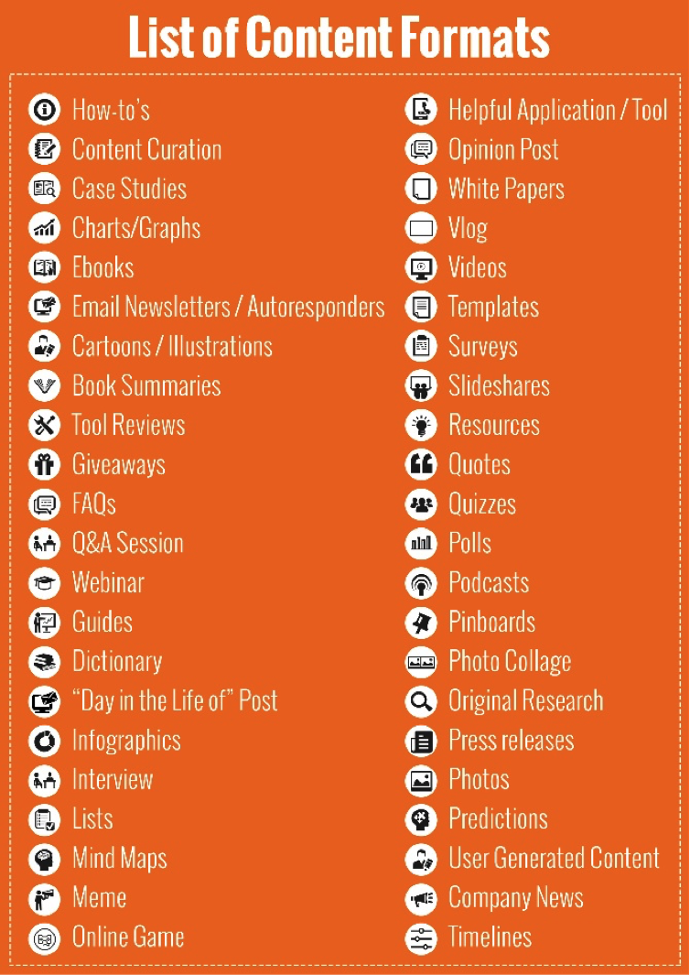
(Courtesy: HubSpot)
Whichever format you choose for your content, it's imperative your content is created to capture the audiences’ eye. Answering their questions, stirring their emotions and giving them an unforgettable experience. Only then do you have a chance to shine and connect with your User Personas. (Here’s a quick guide (infographic) from CMI on 31 Type of Content We Crave)
2. Content Distribution & Promotion
The content you produced is only worthwhile if it gets found by a wide range of audiences and specifically by your Target Personas.
Social Media platforms like; Facebook, LinkedIn, Twitter, Instagram, Pinterest, etc., work as a great amplifier to your content, which could help in sending sizable amount of inbound ‘organic traffic’ to your site.
It pays to work on a Social Media strategy, before you go ahead with promoting and sharing your stories in these social networking sites. A consistent brand profile in all Social Media platforms with similar ‘handles’ will accentuate your brand image amongst your followers.
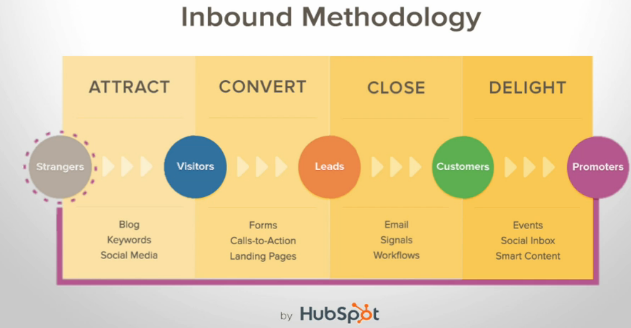
Building user/customer databases through email lists (subscription list) is a great way to engage your customers and leads, and drives traffic and conversion through your content.
A periodic Newsletter on your blogs, products, and customer stories can go a long way in nurturing the relationship with your existing customers and forge new ones.
3. Content Analytics & Performance
Now that you have a consistent flow of engaging content with a robust distribution strategy in place, it's time we looked into how your content is performing.
In other words: who’s visiting your site? From which channels? Which content is getting viewed the most? How better can you attract your audience so they visit more often? And, similar engagement statistics, which Content Strategists of today people crave?
These statistics are generally provided by Content Analytics Software which helps to gauge or visualise the volume of content that has been created, its nature and how it's being consumed.
Some of the free tools available are; Google Analytics, Piwik, Open Web Analytics, SEMrush, Moz Keyword Explorer, etc. All of these tools come with various features such as event tracking, visitor maps, keyword search, heat maps, mouse movement tracker and many more.
If you don’t mind investing a bit of time and effort and really pump up your content marketing game, you could opt for a complete solution offered by HubSpot with their Inbound Marketing Software. The tools offered include a CRM and Sales & Marketing software which supports you in all aspects related to content creation.
That brings us to the end of this blog…
When authorities like Seth Godin say that Content Marketing is the only marketing left, it does compel us to think - How on earth are we to rise above this deluge of crappy content and stand out as the purple cow that demands all the attention?
The answer lies, as Doug Kessler says; "in building ‘Great Content Brands’. The ones that will survive the great tidal waves of oncoming ‘content tsunami’, and will happily float above the troubled waters, with its image perfectly secured in the minds of its audiences as the most sought after authorities and thought leaders."
Have someting to add, we'd love to hear from you! Contact Andy Fox (me) on 03 5249 5570 or at andy@element7digital.com.au
For our full story go to our digital identity, element7digital.com.au