
Today we find ourselves immersed in a world of ‘information’ where we're constantly bombarded with vast amounts of content for us to consume. It’s also getting harder to stand out from the crowd and make a meaningful impact with the regular ‘run-of-the-mill’ content.
The need to find ways to make our content personable, memorable, engaging and interactive has never been greater, because content that's produced to simply ‘read’, is increasingly getting lost in the crowd. Such ‘static’ content gets forgotten and overlooked in favour of more ‘attention grabbing’ and ‘stimulating’ experiences generated through ‘Interactive Content’.
Estimates say, 53% of Content Marketers use ‘Interactive Content’ to influence their buyer’s journey.
SnapApp defines Interactive Content as: Anything that requires the participants’ active engagement – more than simply reading or watching the content. In return for that engagement, participants receive real-time, hyper-relevant results they care about.
Below, a conversion study by Demand Metric indicates when examining “very effective” content, interactive is way ahead of passive content for ‘educating the buyer’. 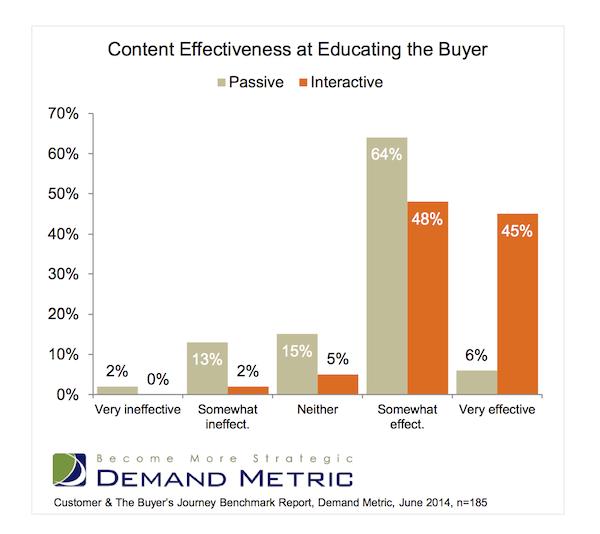
What makes for Interactive Content?
The most common types of Interactive Content include; assessments, benchmarking, knowledge tests, ROI calculators, polls, surveys, quizzes, contests, interactive infographics and live streaming videos.
If you’re looking to be a bit bolder, you may even opt for Virtual Reality (VR) to showcase your products or services.
A study by the Content Marketing Institute reveals the following statistics on the benefits of Interactive Content Marketing:
- 81% agree that interactive content grabs attention.
- 79% agree that interactive content enhances retention of brand messaging when combined with traditional marketing tactics.
- 79% agree that interactive content can have reusable value, resulting in repeat visitors and multiple exposures.
- 75% agree that nongated interactive content can provide a “sample” of the brand, resulting in a higher degree of lead nurturing.
- 67% agree that interactive content provides valuable ways to repurpose existing content.
- 66% agree that audience engagement has increased since their organisation started using interactive content.
Let’s explore some of the ways brands are using interactive content to engage their audiences and boost their sales:
1. CONTESTS
It's this human instinct in us to ‘win’ that drives us to Contests. And the urge is even greater when you can apply minimum effort to earn/win a prize. This drive to earn/win a ‘free’ prize with little interaction or a ‘personal disclosure’, has been the key in boosting social media followers for brands.
Contests can help you gain more qualified leads, as only the right audience is attracted to the kind of prize you give away – unlike giving away ‘freebies’ which may attract any passerby that may not fit your buyer persona profile. It can be used during and after any event to generate the required buzz and excitement to drive traffic.
An example of a well-crafted Contest can be taken from Pat Flynn’s Contest, where he gave away five of his favourite marketing books:


In this lucrative Contest, Pat also uses a neat trick in educating the audience as to how much all the books are worth, which he states to be $147.90, and that and only 5 lucky winners are to receive the prize.
2. INTERACTIVE INFOGRAPHICS
Interactive Infographics uses graphics and data to bring forth an element of dialogue between the content and the user. It creates space to ask questions to your audience, as they process and interact with the graphic, all the while rich data about the users and their place in the buyer’s journey is gathered.
A superb example of an ‘interactive’ infographic is the Washington Post’s ‘Scaling Everest’ infographic. It's a dynamic content which showcases and invites you to experience what the climbers actually face throughout the journey, right from the sea level to the summit of Everest at 29,029 feet high.

The infographic is a compilation of images, facts, graphics and sounds of the climbers who scaled the tallest peak. As soon as you log onto the page, you are prompted to ‘start the journey’ with a ‘Climb Everest’ floating button, upon clicking it, you're taken right to the bottom of the page – that’s where your journey to Everest starts – from the Sea Level.

During your climb to the summit, you’ll pass Kathmandu, the monkeys (gray langurs), the precarious air strip at Lukla, with its runway perched at a steep angle on a ledge, base camp and more. When you reach the summit, you’ll have covered almost 30 feet of the vertical ‘screen space’, exploring the flora, fauna, history and the stories of the mountain.
Infographics like ‘Scaling Everest’ can be a powerful means to turn your passive users into ‘doers’, who will create lasting memories with your content and will happily engage with your brand or message, over ‘static’ and monotonous content.
3. VIRTUAL REALITY & INTERACRIVE VIDEOS
The closest thing to having your customers buy your products is actually making them experience it first – and this is possible through virtual reality and interactive videos. Virtual Realities (VR) have already taken the gaming industries by storm and are increasingly being seen as an effective medium for niches, like extreme and outdoor sports.
VRs can be a powerful, though maybe a bit expensive way to showcase a brand and its products. An interactive video can incorporate various interactive elements into the video, including; hot spots, questions, calculations, lead generation, etc.
An example below, is from the outdoor clothing company, The North Face, who is already pioneering VR Technology to highlight their products and athletes.

The Virtual Reality video invites to experience filmmaker Renan Ozturk’s Spring 2015 adventure through Nepal. This is a 360º, 3D film which can take you to the journey from Kathmandu city to the Himalayas.
As the climber narrates the story, you can toggle to view the surroundings in ‘action’ and get a ‘real’ feel of the journey!
Finally…
As an intrinsic part of ‘human’ nature, we're always inclined to ‘interact’, and are hard-wired to learn by ‘doing’ rather than through passive learning. And to add to that, mobile technologies have also given us the power to personalise interaction with the world right from the palm of our hands, through smartphones and tablets.
It's only a matter of time before marketers and brands need to deliver their content via interactive means rather than through static web portals, to attract, engage and stimulate the minds of future consumers.
If you'd like further assistance or would like to discuss anything covered today, we'd love to hear from you.
Call Andy Fox (me) on (03) 5249 5570 or email andy@element7digital.com.au
Our Website is element7digital.com.au